ADHD: what is it, and is it a trend? pt 2/2
For part 1, where I talk about what is ADHD and the history of it, check it out here.
What causes ADHD?
There are varying theories as to what causes ADHD, from some saying its purely a trauma response, and others saying it’s a natural neurological variation. Here are some of the things i’ve seen:
There is a strong genetic factor, as it often shows up in families. There doesn’t seem to be a specific gene which actually code for ADHD, but there are some genes which might contribute towards it. There could also be epigenetic factors. Epigenetics are like switches that can be turned on or off in certain circumstances, and those switches can be passed down from parent to child.

There are some other genetically linked diagnosis that can be linked to ADHD too, like hypermobility spectrum disorder and Ehlers Danlos Syndrome. If you’ve ever thought you’re double jointed or bendy, even in just part of your body, it can be worth looking into it a bit more. I had no idea I was actually hypermobile til a couple of years ago and it really shed some lights on lots of my experiences throughout life (and helps explain some of the tiredness I feel when I don’t think I should have reason to be tired). Other things that can be linked include anxiety, POTS (Postural Orthostatic Tachycardia Syndrome), MCAS (Mast Cell Activation Syndrome), eating disorders and giftedness.
Trauma can also be a factor. This could be physical or emotional trauma (and likely one of the big factors for micropreemies). As is inflammation and heavy metal toxicity. Symptoms could also be triggered by food additives, or a deficiency in nutrients. Retained primitive reflexes and issues within the central nervous system could potentially play a part too. I’ll talk more about these in the next blog.
One theory I’ve heard is that ADHD occurs when part of the brain develops at a different rate to another part of the brain so they stop being able to talk to each other effectively. That is why some things are overactive, and other parts seem to be underactive. Helping the slow part speed up and the faster part slow down slightly seems to increase the communication between sides and reduce symptoms.
Others say it is a normal variation in the wiring of our brain. Something that is beneficial historically but can be incompatible with our modern world. Especially a society that rewards linear thinking, logic, and sitting at a desk for hours a day rather than creativity, out of the box thinking and integrating plenty of movement.
This wiring can require more stimulation to become activated, or need less stimulation. Dopamine receptors seem to often be involved. Dopamine is a neurotransmitter and hormone that’s really important for how our bodies and minds work. It’s known as the “feel-good” hormone because it’s linked to pleasure, reward, and motivation. It also plays a part in things like movement, learning, memory, focus, mood, and even sleep. Individuals with ADHD may have differences in the number, sensitivity, or function of these receptors, which can affect dopamine signaling and lead to symptoms like inattention, hyperactivity, and impulsivity. There is also some evidence ADHD is linked to the MTHFR mutation, which could explain some of the additional needs for nutrients, which I’ll talk about more in the next blog.

A theory I’ve heard recently that seems to back up the same conclusions I’m getting to with it, is that neurocomplex wiring, when well supported, can sometimes show up as giftedness, or just not have any obvious symptoms. When not well supported or after a period of burnout or trauma, it can show up and present with symptoms which the DSM refers to as Autism and ADHD. So, someone who has neurocomplex wiring, or neuro diversity, might not meet the diagnostic criteria until later in life after a period that has impacted their nervous system. Especially in women this can come after having children, or during perimenopause, when the brain loses the support of oestrogen, but for anyone it could be after trauma or another form of burnout.
How does it show up?
Commonly understood symptoms of ADHD include hyperactivity, time blindness, impulsivity, racing thoughts, inattention, being easily distracted, and difficulty completing tasks. However, it can show up differently in males and females. Here are some of the differences:
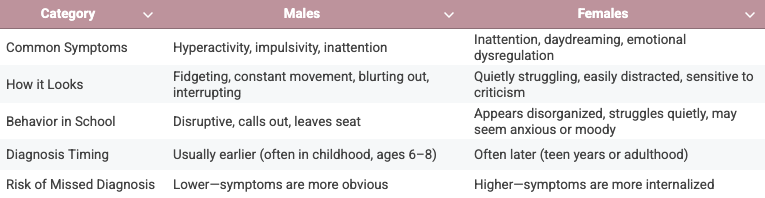
ADHD is often missed in women because they are less likely to have hyperactive behaviours. It could be that they experience inattentive type ADHD, or it could be that their hyperactivity becomes mental, so is less seen. It could also be because many women develop coping mechanisms that mask their symptoms, such as over-preparing or people-pleasing. High-functioning ADHD isn't a medical diagnosis, but it’s a term to describe ADHD that doesn't greatly interfere with your everyday life. You might be high-functioning because you have good coping strategies in place. Or, your ADHD symptoms could be mild or very specific so they only affect a few parts of your work or home life. Achieving a lot at work or school often hides high-functioning ADHD. Symptoms might start to show up more later in life, particularly because fluctuations in estrogen levels can exacerbate ADHD symptoms, especially during menstruation, pregnancy, or menopause, or because of less capacity or experiencing trauma. Many women seem to be getting diagnosed after their children do, and recognising some of the same tendencies within themselves.

One aspect I hear coming up often, particularly in relation to women, is that a lot of people with ADHD tend to feel rejection more severely (also called Rejection Sensitivity Dysphoria (RSD)). And so as a result, many will try anything they can to avoid rejection and the shame that comes with it.
I love this quote from the ADHD Chatter podcast. This particular episode is about AuDHD, which i’m still trying to get my head around, but will share with you when I feel like I have more understanding of it! But in short, ADHD and Autism (AuDHD) can mask each other so well, to the extent that neither can be particularly observable. But this can make the brain incredible chaotic and confusing.
“Like you’re so terrified of being triggered by a rejection or a criticism or not being perfect. And that means that you don’t know how to put boundaries in place. You say yes to everything, you people please. You put everyones needs ahead of your own because you’re so fearful of somebody looking at you as less than perfect, because you intrinsically feel that you’re not. Therefore you put so much effort into appearing so. And the thought of someone seeing through that camouflage is so terrifying that you just, you don’t know how to say no to things”
Another quote from @thatalexhogg
ADHD is spending your whole life being told that you’re not doing your best and that you could do better if you tried harder and worked harder until you believe it yourself, becoming convinced that your best work is actually only average, and there’s a mythical, hypothetical, never-before-see Your Best, which is surely the work of Gods.
So you end up with this inflated ego and stalwart belief that you SHOULD be capable of curing cancer, discovering new planets, composing new opera pieces to take the world by storm, if only you tried harder. But for some inexplicable reason, you simply won’t put your mind and focus on it, and now you hate yourself for not being the spectacular specimen you were taught you ought to be.
And that’s why you end up having these conversations with your therapist where they are like “normal people don’t put this kind of demands and expectations on themselves”, and you dead seriously answer “ Yes, but I’m not normal people.”
And this one from @i.have.adhd.podcast
Most ADHDers are perfectionists. Perfectionism is the most common thought distortion for those with ADHD. The desire to get things right and the fear of failure lead to avoidance, procrastination, and paralysis.
So is it a trend?
Nope. However there is more awareness around how it presents, particularly the differences between males and females. Some people are getting a diagnosis in later life (some even in their 70’s) which is finally explaining what they have been experiencing their whole lives. There is more understanding how the brain works and that societies expectations for conformity and order don’t work for all brain types. Some experts even say it is still underdiagnosed rather than being overdiagnosed.
What you do with the knowledge however, is up to you. In the next blog I’ll talk about some of the things that I’ve learned about that can support the brain and some of the things than can have a negative impact.
Alternatively, if you want to chat with someone who has already done a lot of the research (aka me), feel free to contact me.